Category: Random Thoughts

  • Zwei Königskinder

    Zwei Königskinder

    Have you ever heard this Deutsch volkslieder, “Es Waren Zwei Königskinder“??

    If you have not, you can listen to it on YouTube, there are a lot of videos there. I am writing a couple of stanzas here, so you can get a feel of how it goes… I will explain it in English in a bit.

    Es waren zwei Königskinder,
    die hatten einander so lieb;
    sie konnten zusammen nicht kommen,
    das Wasser war viel zu tief.

    „Ach Liebster, könntest du schwimmen,
    so schwimme doch her zu mir!“
    Drei Kerzen will ich dir anzünden,
    die sollen leuchten zu dir.

    Königskinder means children of kings, or “royal children”

    So, this is how the story goes:

    There were two royal kids, and they loved each other so much. But there’s a catch… they cannot be together. Why?
    Well, the water was too deep! I mean, they were separated by a very deep river between their kingdoms.

    The girl says, “Oh my love, if only you could swim, then swim over here to me! I will light three candles for you; they shall guide you.”

    A wicked nun heard this, who was pretending to be asleep.

    So, unaware of what would happen to him, the boy sets off to cross the river. It was going all good when midway through the river, the nun puts out the candles. Now, without the guiding light, the boy lost his way and drowned in the river.

    The next morning a fisherman well in his boat, threw out his fishing net. He fished out the dead prince right in front of the princess’ house.

    The princess wraps him around her arms and kissed his pale mouth. She says, “Alas, that I must live and you are in the bottom.”

    She then wrapped herself in a cloak and jumped in the river saying, “Farewell, you proud mother, we will now be together.”

    You would find it pretty tragic, right? Well, yeah, it is a tragic piece of story. It is the story which carries the common trope of unification in death that many star-crossed love stories carry such as, dare I say, Romeo and Juliet.

    You would find such stories in many other cultures as well, like Hero and Leander in Greek, Heer – Ranjha in Punjabi (Indian), Pyramus and Thisbe in Roman… the list goes on. They all have one thing in common… Union in Death.

    The barrier dissolves, the world shuts up, and finally, finally, the lovers belong to each other without interruption. Yeah, not in life, not in the way we naively hope for it, but still… something. A closing of the gap. A final refusal of separation.

    And that’s where it starts to feel strange to me.

    Because if you look at all these stories… the boy drowning in the river, the girl following him into it, Romeo and Juliet lying side by side in a tomb, Hero and Leander pulled together by the same water that kept them apart, Heer Ranjha, Pyramus and Thisbe, they all promise the same quiet resolution:

    “You couldn’t have each other in life… but don’t worry, you will not remain apart.”

    Death, in these stories, is not just an ending. It’s mercy.

    I think that they did get what they wanted, even though life never let them together, death did. And that is why, guys, I respect death more than the life. Death doesn’t discriminate; it doesn’t put you through hardships and it certainly doesn’t ask you to prove that you deserve what you already feel. Death doesn’t negotiate. It doesn’t care about the river. It removes it.

    I envy them.

    I envy the princess, I envy Hero, I envy Ranjha. They had the luxury of being together with their love. The real tragedy is not even getting that simple pleasure. The real tragedy is suffering alone, lamenting.

    Tragedy is there being no river to cross, no final leap, no poetic symmetry where two people end up together? When the story just… stops? No union in life. No union in death. No final scene where the distance collapses into nothing. Just one person here. And the other… somewhere that cannot be reached, not even in the way these stories promise.

    I was thinking, how come the princes gets to say, “We will now be together!” and I do not? And that’s the part that keeps snagging in my head like a loose thread you can’t stop pulling.

    Because what gives them that right? Not in some moral sense, not in a “who deserves what” kind of way. Life has never played fair enough for that question to even make sense, but in a narrative sense.

    They get an ending.

    And me?

    It feels almost like I’ve been written into the wrong genre. Like I showed up expecting a tragedy, and instead I got something worse.

    Sometimes I think what if I did not love her that much to be together with her? Why do I have to think about other people, people who love me? The princess didn’t, neither did any of them.

    It’s not that I have not tried to be with her, I did, but the waves always threw me off to the shore. So, there is also this thought of keeping the love alive. The love will persevere as long as I live. Nobody will be there to love her if I die. At least in this material world. So, I guess I have to somewhat keep doing that, as long as I live.

    I had a talk with my friend, she said, “You have to move on, find new people.”

    Well then, what is the fucking point of me not throwing myself in the river like the princess? What is the point if I do not wake up feeling heavy every fucking morning? I am supposed to be the flagbearer of our love. The day I forget to do that, is the day our love dies, and there will never be any union, ever.

    I have to wait for the union in death I guess, maybe that’s not a tragedy in the classical sense. Maybe it’s something lonelier than that.
  • Things I Thought I Lost

    Things I Thought I Lost

    Hi!

    So, umm, where the fuck was I for five months? Well, not that you care, I took a break from everything.

    Wow… It’s been five months! FIVE FUCKING MONTHS!!

    Five months is a strange amount of time. Long enough to change everything, short enough that nothing actually changes. Weird. It’s like I paused a movie and then resumed it sometime later, except I’m not sure if I am watching the same movie anymore.

    Well, to tell you, I was somewhere else. Not geographically. I mean yes, physically too. But mostly… somewhere inside my own head. Which is funny, because I’m still there.

    It is so hard to think and write about things, you know. I really do not know what to talk about. A lot has happened since I last posted here, but nothing you would wanna hear about. 

    I changed my major to Astrophysics.

    Well, I wrote a whole lot of bullshit about how I used to love Astro. How I couldn’t do that after S. I think I believed that at the time. Or at least I wanted to. It sounded convincing enough, like one of those stories you tell yourself so that things make sense in retrospect. As if grief has preferences. As if it carefully selects which parts of your life it wants to ruin and which ones it politely leaves untouched.

    But that’s not how it works, right?

    It’s messier than that. Much lazier too. I remember thinking I couldn’t look at the sky anymore without thinking of her. Which is a very dramatic thing to say, and also slightly inconvenient, considering the sky is… everywhere. So I stopped looking. Or at least I told myself I did.

    The funny thing is, astrophysics isn’t really about looking at the sky. Not in the romantic sense. It’s equations. It’s models. It’s approximations. It’s taking something infinitely vast and reducing it to symbols on paper that barely behave. And somehow, that made it easier. Because equations don’t remember people. They don’t care who you lost or why you stopped showing up to class or why your brain feels like it’s buffering all the time. They just sit there, waiting for you to make sense of them.

    I think I confused loving something with being able to feel it. And when I couldn’t feel anything properly, I assumed the love was gone too. But maybe it was just… muted. Like everything else.

    So yeah, I switched back. Not because I had some grand realization or because I suddenly healed or anything cinematic like that. It was more like this quiet, almost accidental decision. Like picking up a book you once liked, not expecting much, and realizing you still remember how to read it. I still don’t know if I love it the same way. Or if I love anything the same way anymore. But I’m here, sitting in lectures, pretending to understand galaxies while barely understanding myself.

    I also think this is what S would have wanted for me, to not give up on her. On myself!

    But, it also feels weird getting back to Astrophysics. I had no friends there, I sat alone in every lecture. It felt like I am some alien to the class. But I am not gonna give up. I would most likely meet new people and make new friends, who knows!

    I remember when I first came here. I used to be different. I remember that version of me very clearly. He was loud. Slightly annoying, probably. Made bad jokes in class and laughed at them himself. Talked to people without overthinking every single word like it was a high-stakes experiment. Now every conversation feels like I’m solving a differential equation in real time. I literally hate the things I choose to be, really. I think something in me just… shrank. Not disappeared. That would’ve been easier to explain. Just reduced. Compressed into something quieter.

    But here’s the thing. I don’t think this is permanent. And I don’t say that in a motivational-poster way. No “you got this!!” nonsense. More like… statistically speaking, this version of me cannot be the final one. That would be a very boring trajectory.

    So yeah.

    I’ll probably sit alone for a while. Probably overthink every interaction. Or walk into lectures feeling like I accidentally entered the wrong universe. But maybe one day I’ll say something stupid again. And maybe someone will laugh. And maybe I won’t analyze it afterwards like it’s data. Who Knows.

    What else…?

    Right. I’ve also been thinking about memory. Like… how much of a person is just memory? If I forget enough things—about people, about myself… do I slowly become someone else? Or do I just become a worse version of the same person?

    Because lately, I don’t trust my memory much. It feels… edited. Like someone cut out random scenes and stitched the rest back together without telling me.

    And then there’s this weird thing… I don’t feel things the way I used to, but I still remember how they’re supposed to feel. Which is unsettling. It’s like reading emotions off a script.

    “Oh, this is the part where I should feel excited.”
    “This is where I should laugh.”
    “This is where it should hurt.”

    And sometimes it does. But slightly delayed like bad audio syncing.

    Hey, I also changed the theme of this website to something light and a bit more positive from that weird dark psychopathic theme. That is not how my thoughts should feel like. It’s unsettling to me.

    Oh God, this post feels all over the place… it actually is. But then again, so am I!

    Umm… one more thing, I would want myself to be more organized and regular with posting things here. Not because you guys love to read about shitty thoughts a deranged brain, but because I want to keep track of myself.

    If you’re reading this, I hope you’re doing okay. And if you’re not, well… I guess that makes two of us.

    Bis Später!

  • Six p.m. is Not Dinner

    Six p.m. is Not Dinner

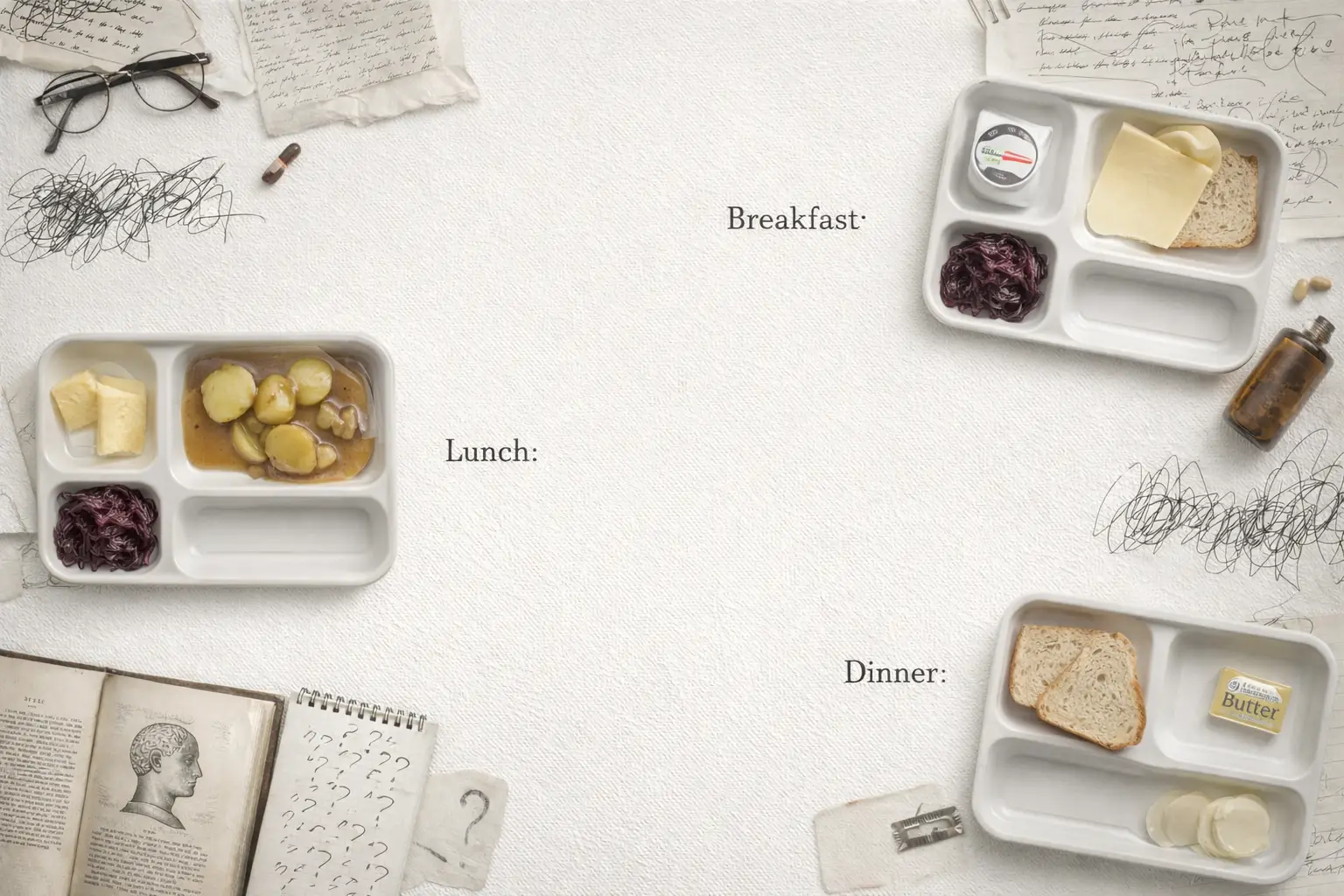
    German hospital food really is a full anthropological study, especially Track 2. It’s like they designed the meals by asking, “What if we removed joy?” And then doubled down.

    Breakfast:
    Cold bread. Cold cheese. Cold silence.
    Lunch:
    Some permutation of potatoes trying their best.
    Dinner:
    Cold bread again, as if the bread committed a crime and must serve a life sentence.

    And 6 pm?? My friend, that’s not dinner-time. That’s intermission. No wonder you’re starving by night — your body is like, “Excuse me, where is the actual food that sustains life?”

    I’ve only been here a couple of days, but the food alone is enough to make me question the architecture of civilization. You know when anthropologists talk about “ritual meals” and “shared cultural practices”? I feel like I’m inside one of those BBC documentaries narrated by David Attenborough: “Observe the German patient, in his natural habitat, quietly accepting a slice of unheated bread as his final meal of the day.”

    But the food isn’t even the whole story. It’s just the most edible symptom of a larger thing: the cultural shock, the unspoken rules, the absolute German precision even in places that feel like they should permit a little chaos.

    I’ve been here only a short while, but the routine hits me like a foreign alphabet. Everything runs on a clock that’s not mine. Meals at strange hours, lights out early, nurses walking with the confidence of people who know exactly how long the universe should take. Meanwhile I’m sitting there, a student who still thinks dinner should happen when the sun has given up for the day, trying to understand why everyone here seems perfectly okay eating a refrigerator at 6 pm.

    There is also the way they check on you. Not intrusive, not dramatic, just… scheduled. “Minute 27… time to ask him if he slept.” I’m not used to care delivered with this mathematical consistency. Here, care is a line item. Necessary, structured, efficient. And I’m learning to live inside this efficiency without losing the softness I grew up with.

    I have been living in Germany for one year and have never experienced this level of culture shock. I knew living in Germany required adjustment, but this is special edition level of adjustment. A speed run of cultural assimilation under fluorescent lights.

    Inside the hospital, time behaves differently. There are no responsibilities except to exist. No racing thoughts about assignments or emails or cooking or grocery shopping. Just… being here. Breathing here. Eating the culinary tragedy they call Abendbrot. And feeling things I’ve ignored for months because there was always something else demanding attention.

    It’s strange how getting admitted feels like both a collapse and a relief. A kind of surrender but also like my body speaking, “Stop. We can’t carry this alone anymore.”

    But the cultural shock hits like waves. When a nurse knocks even when the door is open. When people speak so gently it almost feels unreal. When someone says “You don’t have to explain if you don’t want to.” When dinner arrives and your entire ancestral lineage whispers, “Beta… where is the dal??”

    Nothing prepares you for the moment you realize that survival tastes different in every country.

    And my room… my room is a fucking box of depression. Four walls that press in like they’re taking notes on my sadness. Even the window opens to the back of hospital corridor.

    I don’t know how long I’ll be here. A few days, maybe a little more. But something in me knows this pause is necessary, even if uncomfortable. Even if unfamiliar. Even if the bread has no business being that cold.

    Healing is also a kind of migration. You leave the familiar terrain of suffering and try to enter a new landscape. The border crossing is messy, disorienting. The language is strange. The customs are different. The food is suspicious. But eventually, if you stay long enough, something shifts. You learn the rhythms. You find the warmth. You meet yourself again.

    But one thing for sure, I will not settle for cold breads for the dinner. It shouldn’t even be called the dinner… 6 p.m. is no dinner.

    They have asked me to provide a list of things which I cannot eat. And this is my list:

    idk if they’ll agree on the requests

    I am letting myself be taken care of. Letting myself soften. Letting myself slow down enough to finally feel the things I’ve survived.

    And maybe, someday, when I’m outside again, I’ll look back and laugh at the cold bread and the quiet halls and the cultural confusion. Or maybe I’ll just carry this place with me as the first moment in months when life paused long enough for me to notice myself again.

    But never in my life I will start liking the German eating habits.

  • The Trade

    The Trade

    TW: SELF HARM!!!

    It’s been a few days since that night, and I’m still trying to decide what was real and what was dream. The voices were louder than they’ve been in months, and there was a moment when the whole room seemed to tilt. I remember the blur of it more than the detail.

    When they started shouting over each other, it was like the walls pulsed. I tried to focus on one sound, one word, anything that could anchor me, but everything slid sideways.

    Then they made me an offer I could not refuse.
    They told me they could give me silence.
    A trade.
    What did I have to do?? Inflict pain, uncage it, let it flow.
    I don’t remember the logic of it, just that the idea of quiet felt holy. I thought if I could stop the noise, even for a few minutes, maybe I’d find myself again.
    When it finally went still, I didn’t feel relief, I felt numb. I watched myself as if from a few feet away, detached and weightless. It should have frightened me, but it didn’t. It felt like floating.

    I did left a message to my sister before all of it. But she was sleeping. Time runs 4 hours 30 minutes ahead of me there.

    A blade? Knife? Or maybe a cardboard cutter? Something so ordinary it shouldn’t hold that kind of power. But it did.
    I watched it rush out as fast as it can as if my body had been waiting for that one small opening. The blood came like water released from a dam… urgent, wild, free. It didn’t drip; it raced. It wanted out. And for a moment, I wasn’t scared. Just… quiet.
    Watching it, I remember thinking how unreal it looked. Like it wasn’t mine. Like I was only witnessing the event, detached from it, like an outsider to my own biological breakdown.

    Today I was on a video call with my mom and my sister. Mom noticed before I could cover anything up. She asked what happened, then started talking fast, praying under her breath between sentences. My sister hovered below her, already searching for remedies. Control your mind, meditate, breathe, think of God, listen to bhajans. Their worry was real, but it felt like a language I couldn’t speak. They believe faith can reorder chemistry.

    Every time someone says, “You just have to control your thoughts,” I want to hand them my brain for five minutes. Let them see what it means when your thoughts stop being yours. When your mind speaks back with its own voice. When you live inside a chorus you never auditioned for.

    They think it’s laziness, weakness, demons, karma, moral decay, everything except what it is: an illness that rewires perception, that changes the way sound and thought are built. It’s not romantic. It’s not poetic. It’s a fucking work. Every single day.

    I don’t need to “think positive.” I need people to stop acting like positivity is a cure for physics. I need them to stop hiding behind the word spirituality when what they mean is discomfort. Because that is the truth. They see it as chaos invading the safe order of their lives, and instead of sitting in that discomfort, they try to fix me back into their idea of normal.

    Normal.
    I’m tired of it.
    Normal people want stories of recovery that sound like redemption arcs. The brave patient, the healing music, the miracle meditation. They want illnesses to be neat, instructive, inspiring.
    It isn’t.
    It’s messy, tedious, cyclical.

    I wanted to shout out my disagreement loud. But I didn’t argue.
    I told them I’d try the breathing exercises.
    Sometimes I even do.
    Not because I expect them to fix anything, but because breath is something solid to hold when everything else turns abstract.
    The rhythm of air going in and out is proof of a body still here.
    And maybe that’s all I need some days.

    They meant well. They always do. But there’s this vast distance between caring and comprehension. They see it as something moral, something that can be disciplined or prayed away. I don’t blame them. It’s what the world taught them, that suffering is a failure of faith.

    I tried, once, to explain what it’s like. That the voices aren’t metaphors or moods, that they bend sound itself, that they rewrite the air around you. That it isn’t about willpower. It’s not about weak minds or strong hearts. It’s about misfired signals, about synapses painting over reality with their own colors.
    But my words never land the way I mean them to.

    But that does not deny the fact that I hate how “mental health awareness” gets packaged online. Pastel graphics, quotes about self-love, the illusion that you can fix your brain with morning routines. It’s a performance of empathy, not empathy itself.

    Awareness isn’t the same as understanding. Understanding requires discomfort. It means asking hard questions, staying with ugly answers.

    The voices are quieter now, though not gone. They hover like background noise.

    The night of the trade feels far away now. I am somewhat ashamed of myself. But I forgive myself too. There was no other option. I know it could happen again; that’s the nature of this thing. But I also know I’ll be ready in ways I wasn’t before. Or maybe I’ll give in again, who knows.

  • Astro

    Astro

    Astrophysics was my love.

    I wonder why I left it and started doing solid state physics.
    Maybe because I got influenced by M, “You will have more options here.” maybe it was that quiet bitterness that comes after too many small sacrifices, the whisper that says, “Why should I be the one to sacrifice every time?”

    Maybe I ran away.
    Maybe I was coward enough to escape the burden of expectation, the endless chase for a discovery that might never come.
    Or maybe the purpose of doing it died with S.
    She loved the stars more than I ever could. For her, astronomy wasn’t just science; it was intimacy with the infinite. She looked at the night sky like someone remembering home. After she was gone, the sky stopped being a place to look into and became a place to look at.

    Sometimes I think I didn’t just leave astrophysics. I left a version of myself that still believed in wonder. To be very honest, I never liked solid state physics. Crystals, currents, and lattices… they feel too confined, too obedient. The equations don’t wander; they stay where they’re told. Everything is measurable, everything repeatable. There’s no mystery left, no silence that stretches into awe.

    But I like what I get to do in the labs. Labs are fun in solid state. I am currently working on implementation of a python based experimental control framework for optical characterization of semiconductor quantum devices. It’s intricate, frustrating, and strangely alive. There’s a quiet satisfaction in watching machines respond to code.

    It’s fun, yes.
    But sometimes, in the middle of coding, I catch myself thinking about photons traveling through interstellar space. The real ones, not the ones bouncing inside a cryostat. The difference between cosmic light and lab light is distance. Scale. Meaning. The photons I measure now are domesticated; they behave. The ones from the stars arrive wild, aged, touched by the dust of centuries. I miss that kind of light.

    I also got my office today. I have to share this office with M.
    Of course. The universe has a sense of humor. I wanted distance, but somehow, I keep getting pulled back into her orbit. She doesn’t mean harm, but her presence is gravity: subtle, inevitable, unasked for.

    She wasn’t there today, that was a relief.

    I sat alone for a while, pretending to arrange my things, but really, I was just looking at the patch of sky visible through the window. It’s not much, half a rectangle of fading blue. I wonder what S would have said about it. Probably something about how even city skies have stories if you learn to squint right.

    I think about S often when I code.
    How she’d tease me for giving up the cosmos for semiconductors.
    How she’d say, “You traded galaxies for grids.”
    She’d laugh, that half-sincere, half-sarcastic laugh she always had when she was right. And I’d pretend to defend myself, “But it is still physics.”
    And she’d say, “Yes, but not the kind that breathes.”

    I don’t think I ever told her, but I envied how easily she could love things that were beyond reach. I always wanted to understand the universe; she wanted to belong to it.

    Okay okay… this post is becoming more about S and less about my thoughts. But then again, I am thinking about S, so maybe that’s fair.

    I also went to the exercise class for Introduction to Solid State Physics I. The professor was livid when none of us showed interest in presenting the solutions to the problems. And when a group did, we as audience were half dead. He said, “You guys are master’s students. You need to keep up. This is not the standard we are setting here. This is not acceptable.”

    He seems passionate about the subject. You can see it. The way his voice sharpens when he talks about Drude, or Sommerfeld Model, the way he looks disappointed when we don’t respond. He loves this subject. I almost envy that.

    But on the other hand, there’s me.
    Too shy. Too underconfident to go and present in front of the class.

    And even when I want to, my mind betrays me. Words vanish mid-sentence. My speech stumbles; thoughts scatter like frightened birds. I hate it. The feeling of being trapped behind a glass wall, knowing what you want to say but unable to make the sound.

    Negative symptoms of Schiz. I hate them more than the positive ones. The voices at least come and go, but the emptiness stays. The hesitation, the quiet disconnection… it builds a wall between thought and speech.

    Maybe that’s why I prefer silence.
    Silence doesn’t humiliate you.
    Silence doesn’t misfire halfway through a sentence

    And I don’t think professors understand how much courage it takes just to stand up and say something when you feel that way. They think silence is laziness, but sometimes silence is survival.

    Anyway, when I look back, so much of my decisions depend on other people rather than mine. How strange it is, how much of my life seems shaped by other people’s gravity.

    S said “look up,” and I did. Until I couldn’t anymore.
    M said “options,” and I changed my orbit.

    Maybe that’s what most of us do: move around the pull of other people’s certainties until we can’t tell which direction was originally ours. I keep wondering who I would have been if I’d stayed stubborn, if I’d fought harder for the sky. Would I have been braver or just lonelier in a different way?

    I don’t know if I’ll ever go back to astrophysics.
    Maybe I couldn’t even if I tried. The math has moved on, the people have moved on, and maybe the version of me that once belonged there no longer exists.

    Still, I keep some ritual. I try to look at the night sky when I am alone. Try to find stories in the sky. If I get my eyes on a cluster of stars, I try to name it, like an apology. I imagine S somewhere in that direction, laughing at my sentimentality.

    “You’re still at it,” she’d say.


  • Glass Theory

    Glass Theory

    I have a theory about glass.

    Not the kind that shatters, but the kind that waits.
    Windows, screens, lenses.
    Surfaces that pretend to separate us from the world but only thinly.
    They don’t really divide anything; they just slow light down long enough for us to mistake reflection for distance.

    I’ve been staring at my window a lot lately. From the right angle, I can see both the street outside and the room behind me, layered like two versions of reality trying to coexist.
    If I move slightly, one fades and the other takes over. Sometimes I think that’s all consciousness is.

    They often ask if schizophrenia feels like breaking.
    It doesn’t.
    It feels like transparency gone wrong. Like the glass itself starts remembering every image it ever reflected.
    All the moments overlap. The world doesn’t fracture; it accumulates.

    I have this dream. I drop a beaker in the lab.
    It doesn’t explode the way you expect glass to. It just cracks cleanly, in silence. I remember how the fracture line looks like lightning trapped mid-air, as if something had been caught trying to escape.
    My lab partner says, “Don’t touch it, you’ll cut yourself.”
    But I am already holding one half in my palm, watching how it still managed to reflect my face, only twice now, separated by a thin edge of absence.

    I don’t feel the cut at first. The blood comes quietly, like condensation.
    And I think: this is what thought looks like when it breaks… still reflective, still capable of image, but no longer whole enough to trust.

    I always think of that dream and I keep replaying the sound the glass didn’t make.
    There’s something eerie about silent fractures.

    Anyway, this summer, I was in the lab, trying to carry out an experiment on Photoluminescence. The supervisor walked past, asked if I had measured the spectra of the second unknown sample.
    I said yes, though I hadn’t. The data didn’t make sense; light was behaving too politely for the chaos of my head that day.
    He leaned over the table, looked through the lens, and said, “You know, even when glass looks clear, it’s still absorbing something.”
    That stayed with me.
    Maybe minds are like that too. They pass most things through but absorb just enough to tint everything after. You can spend years pretending transparency, but the color of what you’ve carried shows sooner or later.

    There was a student once, someone I met at the cafeteria. He told me he could always tell when the world was “slightly off,” like when you pick up a cup that’s heavier than you expected.
    We talked about gravitational lensing. How the path of light bends when it travels near a heavenly body, how truth bends too. He said he sometimes looked into mirrors and felt delayed, as if his reflection were thinking before him. I told him I knew that feeling.

    He laughed and said, “So you’re one of us.”
    I didn’t ask what us meant. Sometimes belonging doesn’t need to be defined, only recognized.

    He also told me that old mirrors were made of silver, and over time they tarnish from the edges, slowly devouring their own reflection.
    Maybe minds work the same way.
    They oxidize from within; memories reacting with air, turning dark at the corners. You can still see through them, but not clearly. There’s always a shadow of what used to be.

    Some days I try to catalogue the distortions. But there’s a danger in measuring too much; sooner or later, the observation becomes participation. You start altering what you’re observing just by existing near it.

    People think clarity is the goal… to see things as they are. But maybe clarity is just another illusion, another kind of blindness we romanticize because it promises simplicity. Real vision, the kind that hurts, is when the glass disappears and you realize there was never a wall at all.

    There’s a quiet violence in seeing too clearly. When you can no longer mistake reflections for reality, every surface feels thinner. You start noticing the fine cracks in everything.

    I used to think that if I could name the cracks, I could fix them. That if I understood their geometry, their stress lines, their angle of impact, I could reverse the break.

    The thing about living with this mind is that you begin to hear frequencies no one else does. Not literal sound, though sometimes that too, but tones of meaning.
    Every word someone says carries a hum, a vibration possibly.
    I keep listening for what hides beneath what’s said. It’s exhausting, but it feels honest.

    There was M.

    For a while, she was the clearest surface I knew. Everything reflected cleanly in her. We spoke in long sentences that felt like experiments: hypothesis, response, correction. I kept thinking if I explained myself precisely enough, she’d see me. But clarity has a cost. The closer we got, the more our images overlapped, until neither of us could tell whose light was whose.

    She said I was “too transparent,” that she could see through me.
    I thought it was a compliment until I realized she wasn’t looking at me anymore, just through.
    Every time I tried to hold shape, I felt the temperature drop a little, like a window fogging from the inside.

    M had a way of convincing me that my reflection was inaccurate, that her version of me was the real one.
    And for a while, I believed her.
    It’s easy to mistake someone else’s gaze for light when you’ve been standing in the dark too long.

    When she left, I remember touching the spot on my wrist where her hand had been, as if glass could still remember fingerprints.
    It does, in a way.

    When it ended, it wasn’t an explosion. More like annealing. A slow cooling that leaves stress frozen inside the glass.
    Sometimes I think we weren’t in love as much as we were caught in a feedback loop, each trying to correct the other’s distortion, each making the image worse.

    And there was also S.

    She never liked glass. She said it was too honest, that it never softened what it saw. She used to tilt mirrors slightly, as if a few degrees of imperfection made reflection kinder.
    I didn’t understand it then.
    I do now.

    She had this way of speaking… like each sentence was a piece of stained glass, colors fitted together by care rather than symmetry. You could see the cracks, but they caught light instead of hiding it. Her laughter was transparent too, but in a warmer spectrum. It wasn’t the brittle kind that breaks silence; it filled it, reshaped it, made it breathable.

    I think she was the first person who taught me that not every surface has to reflect; some can receive. With her, I didn’t feel the need to explain my own refractions. She saw them and didn’t try to correct the image. It’s strange, how that kind of gentleness can feel both eternal and brief at once.

    When I write about her, I think of the way certain mornings still hold her shape in the light. Sometimes I catch myself arranging sentences the way she used to arrange her thoughts. Slowly, deliberately, with a kind of mercy toward whatever couldn’t be fixed.

    Sometimes I wish what she wished to come true. That we were never perturbed and lived happily ever after. But that is not what we got. According to her, she was bad at life, and I was terrible at my beauty. She used to say it half-smiling, as if the confession itself was a joke neither of us wanted to end.

    What she meant, I think, was that she could never stay long in the smooth version of the world, and I could never see myself without distortion. We were both made of refraction. She bent toward compassion, I bent toward doubt.

  • Silk

    Silk

    I didn’t sleep last night. Not out of anxiety or excitement. Just an absence of tiredness that didn’t make sense.

    I also didn’t go to the labs. I told myself I’d get up, get dressed, go to the lab. But I didn’t. The idea of movement felt absurd. The kind of effort that belongs to another version of me, one that I couldn’t locate anymore.

    Weird.

    The guy I know once told me that burning silk releases hydrogen cyanide. And he told me perfect steps about how to burn it slowly and trap the HCN in a glass bottle and when the concentration is enough, how I should inhale it. Like a well explained manual to off oneself.
    There was no humor in his voice, no detachment, just the slow seriousness of someone who has thought about it too much.

    It’s easy to say it’s just chemistry, that the reaction is impersonal: silk contains nitrogen, fire provides heat, gas forms. But that’s not how it feels when you picture it. It’s quiet, precise, almost deliberate. A fabric meant for softness turned fatal by contact with flame.
    A slow, invisible undoing.

    I wonder what his reason was behind telling me. It’s not like that I would experiment myself with it. Maybe just to put the thought of it in my head. But then again, thoughts don’t just sit quietly once they’re placed.

    Sometimes I think people tell you strange things not because they want you to know them, but because they want to see what happens inside you when you do.

    I stayed in bed long enough for the day to pass without having a sense of time. Time doesn’t feel like a line anymore, more like a damp cloth I was stuck inside. Whatever.

    I remember once reading that every material has a breaking point. A temperature, a stress limit, a force that makes it yield. Maybe minds have theirs too. Only they don’t always shatter loudly. Sometimes they just quietly stop trying to hold shape.

    When the guy told me about the silk, what I really remember is not the method, though the precision stayed with me, but the tone. That calm practiced tone. The kind that makes horror sound like routine. It made me wonder how many times a person has to rehearse despair before it sounds like instruction. It’s strange, the way we talk about death when we are alive.

    Still, it stuck with me. Not because I wanted to do it, but because of how possible it sounded. How ordinary the extraordinary can be when explained step by step.
    A recipe. A formula.
    Maybe that’s what scares me most; not the act, but the normalcy of imagining it.

    It’s a strange kind of inheritance — to be given not an object or memory, but an idea you didn’t ask for. I didn’t want it, but I can’t throw it away either. It follows me, not as temptation, but as curiosity.
    What kind of mind builds such careful instructions for its own ending?

    I’ve been wondering ever since if the world would be less terrifying if everything, even despair, could be mapped.
    If every feeling came with a flowchart and a margin of error.
    Maybe that’s why people like him do it. Not to act on the plan, but to feel that there is a plan.

    And in a way, I understand that.
    Because sometimes, the scariest thing isn’t the darkness itself but it’s not knowing where it starts or ends. It’s the vagueness that consumes you, not the act.

    I don’t think he was trying to plant the idea of death in my head. I think he was trying to show me the blueprint of control, what it looks like when a person sketches an escape route, not to walk through it, but to know it’s there. To keep it folded, like a map in the pocket, just in case. But that’s the problem with maps. Once you know the route, it doesn’t disappear. Even if you never take it, your mind keeps tracing it during quiet hours, testing where the turns lead, wondering how long the path really is.

    But I wonder what a way it would be to go like that! I’ve always believed that life should end with some form of authorship, that the closing line shouldn’t be an accident. The thought isn’t about dying; it’s about control, about the strange pride of being able to decide how something ends when so much else is decided for you. Maybe that’s why ordinary endings feel small. Because they happen without permission. They arrive like weather, unannounced.

    There should be something unique, if not grand, in the way we say goodbye. Still, when I picture it, I realize how little mastery there really is. No one ever pulls off an ending the way they imagine. It’s never cinematic, never complete.

    To pull off this would be somewhat of an achievement in its own. But then again, with silk, you would go painless. A very close friend of mine used to say that there is no pride in dying if you didn’t feel the dying. That dying should be strenuous. For something to be experienced for the last time.

    How do you build something for that?
    Maybe you don’t. Maybe the whole point is that you try and fail. You can design endings in your head, shape them like blueprints, but the body has its own stubborn plans. It clings. It resists instruction.

    She said that dying should be strenuous, something to feel for the last time. But what if living is strenuous? Would you still go chasing pride? Or would you just want to not feel anything for the last time?

    Sometimes I think about the people who couldn’t keep walking and the way we retell their stories. We talk about them as if they mastered the art of exit. People I admire had planned it quite beautifully. Sylvia Plath, Anne Sexton, Dalida — they went easily. Maybe life itself was too painful for them. Some have chosen a slightly painful path: Robin Williams, Virginia Woolf. They must have experienced dying. Hanging and drowning should be strenuous.

    There is something about being decisive. To have authority.
    We spend our lives under a thousand quiet forces: expectation, accident, biology, time. Every choice feels half-borrowed. So, when someone seems to take full command of their story, it looks almost sacred, like an act to show them who is in control.

    Sometimes I look in the mirror and see traces of all the versions of me that tried to be decisive. The notes, the plans, the fragments of sentences left open. And I realize how all of them failed, and how that failure has quietly kept me alive.

  • Point Zero

    Point Zero

    Uhh… where to start??

    I think I’ve been trying to begin for a long time.
    Every time I do, the words arrive half-awake, as if they’ve been listening to me think for hours and are too tired to form sentences. Sometimes they just vanish in the world of their own.

    I am here because silence started feeling heavy.
    Not peaceful. Just full.

    I live with a mind that edits reality.
    Sometimes gently. Sometimes like a knife.
    I wake up in one version of the world and go to sleep in another.
    The difference is small but enough to notice, like a picture slightly out of frame.

    There are days when I feel like a scientist watching my own thoughts through a glass wall.
    Taking notes. Recording observations. Hoping they make sense later.
    The variables keep changing.
    The constants refuse to stay constant.
    I live between hypotheses that never settle.

    People like to treat names as answers, but they are really just labels for questions we don’t know how to ask.
    When the doctors said it out loud, I remember feeling both smaller and more visible at the same time.
    As if the world could finally see me, but only through the lens of a word that doesn’t hold the whole picture.

    Schizophrenia.

    It sounds static.
    It sounds distance.
    It doesn’t feel either.
    It feels like living with multiple radios tuned to slightly different stations.
    Sometimes they harmonize.
    Sometimes they scream over each other.
    Most of the time, I’m just trying to keep the volume low enough to think.

    I am not here to explain it. When I write, things seem to slow down. Maybe still a scrawl, but at least comprehensible one.

    I study physics, funny. Though I don’t think I chose it for the equations.
    I think I chose it because it offered an illusion of order.
    We are told that even chaos follows rules, if you look closely enough.
    Maybe that’s what I’m doing here too, trying to find rules for the kind of chaos that lives in me.

    There’s a quiet irony in being someone who measures systems while living inside one that refuses to stay measurable.
    But maybe that’s okay.
    Maybe not everything needs to be solved.
    Some things are meant to be experienced.

    Most days, I wake up to the same questions in my head.
    Are these thoughts mine?
    Is this real?
    Is this still me?
    And somehow, music helps.
    And sunlight through the window.
    And the sound of kids going to school in the morning… ordinary sounds tether me to the world.
    I listen to music all day all night. Even when I am sleeping. I never turn it off.
    Winter is coming… sunlight is very hard to get here in Germany. And kids are quiet too these days.

    I don’t really know what the purpose of this blog is.
    Maybe it’s a diary that doesn’t care about order.
    Maybe it’s a slow archive of moments when I remember how to be human.
    Maybe it’s proof that I existed long enough to write something down.

    The internet is strange.
    It’s both infinite and lonely.
    You can disappear completely here, and still be seen by someone miles away who understands you without knowing why.

    I have not slept today.
    I have to get to labs in the morning. But the thought of lying still feels heavier than being awake.
    The music is playing (“Sugar for the Pill”), and my head keeps talking. Sometimes I think sleep isn’t rest, it’s just another version of thinking… one I don’t control.
    I can’t control my thinking when I am awake either, but sleep unsettles me.

    I mailed my doctor about what’s going in my mind. Why? I do not trust my friends. I do not trust my doctor as well, but I trust her enough to share some of my thoughts. I told her the things I have been hiding from her. She told me that I am not very well. Hah… like I didn’t know that.

    My arm is a mess.

    Today was the first German Language lecture for this semester. When I told the lecturer my name, she started shouting, “Oh, Ash aus diesem Anime, richtig? Wie war der Name?? Wie war der Name??”
    “Pokémon”, I said.
    “Aah… hast du haustiere?”
    “Nein.”
    “Kein Pokémon… EHH?”
    I smiled.

    She was nice. People in Germany are nice. Except for my last doctor. I think he was plotting against me. There was no way of knowing.

    I don’t know how long I’ll keep writing.
    Maybe a month. Maybe years.
    Maybe until the fog clears, or until I stop needing to translate myself.
    Maybe until this voice feels like a place I can live in peacefully.

    For now, this is where I am.
    Not at peace, not in crisis, just somewhere in the middle listening to my own thoughts, letting them turn into words, so they stop feeling like ghosts.

    If you’re reading this, you are part of the experiment now.
    Not the scientific kind, but the human one.