Category: Diary Entry

  • Words from Track 2

    Words from Track 2

    The Check-In

    You know that moment in life when things crumble just enough for you to say, “Ah yes, this is fine,” while everything else burns?
    Yeah. I missed that stage completely and slid headfirst into LWL before I could even process what the hell I was doing.

    The hospital is clean, well-lit, and engineered specifically to remind you that time is a social construct. Days here don’t pass.

    I arrived here with a brain that had decided to screen horror movies on repeat without my permission. Voices, visions, a cocktail of fear served loudly. I walked in scared; they gave me a bed, some paperwork, and a menu of medications I don’t seem to understand. A proper welcome.

    Somewhere deep inside I thought, “Maybe this will help.”

    But the more honest part whispered, “Go home!”

    I ignored both.

    The Food Situation

    German hospital cuisine is a form of character development.
    You think you’re tough? Try eating cold bread at 6 p.m. while everyone else politely spreads butter like they’re in a commercial for dairy products.

    Breakfast: cold bread, cold butter, cold cuts.
    Lunch: lukewarm confusion.
    Dinner: breakfast, again

    I had to write out about what I “cannot eat.” They agreed on providing me soup for the dinner. Not that it’d sate my hunger, but at least I’d get something warm.

    The Voices Return

    Medicine: “We’re working.”
    Voices: “lol no.”

    Two men talking somewhere behind my ears.
    Familiar voices.
    Unwanted guests.
    The kind you don’t even offer tea to because they show up uninvited and start rearranging your thoughts.

    I stared at the ceiling wondering how the hell one argues with a hallucination.

    I went to ask for meds. They handed me Haldol. It looked like it came from a Pokémon evolution chain of sedatives. I swallowed it and hoped for the best. The best did not occur. The voices just lowered their volume, like they were being considerate. What lovely roommates for the night!

    Dreams That Need Their Own Trigger Warnings

    You know how you never die in a dream? Last night I dreamed that I tried to kill myself just to wake up.

    A dream inside a dream inside a panic attack—Christopher Nolan would be proud.
    The anxiety afterwards? Less cinematic.

    I sat on the edge of my bed thinking, “If I tell the nurses, they will absolutely not let me go home.”
    And you know what? I really, deeply, desperately wanted to go home.

    So I didn’t tell them.

    The Desire to Escape Intensifies

    I have been here long enough to realize: I would not survive jail.
    Not because of the danger.
    Not because of the violence.
    But because I cannot eat bread-based meals twice a day at fixed hours like a 19th-century German farmer.

    Also, the door to the ward makes a sound every time it opens.
    A cheerful ding.
    A lie of a sound. Because nothing here is cheerful.

    I asked them if I could go home to bring my tablet. I promised them that I would come back before the earth gets devoured. They didn’t let me.

    I walk circles in the corridor like a zoo animal whose enrichment toy was taken away. Other patients do the same. We do not talk. We just do laps like we were all preparing for some Olympic event called “Don’t Lose Your Mind Relay.”

    The Problem of Being Evaluated

    Every morning a doctor appears like a side character in a video game, asks about sleep, mood, and whether I feel safe.
    And every morning I tell them what I need to: “I’m fine. Better. Improving. Great, actually.”

    Lies.
    All lies.
    I want to go home so badly my bones feel homesick.

    But I know how this works.
    One wrong sentence and they’ll keep me longer “for my safety.”

    I’m scared, but I’m also strategic.

    Survival tip: psychiatrists love the word stable. I drop it into conversations like seasoning.

    The Paranoia Episode

    This one… hit differently.

    Voices came back, louder, sharper. Adi. Prathamesh.
    Except they weren’t there.
    Except my brain insisted they were.

    I felt watched. Followed.
    Hunted by shadows that weren’t real but felt very committed to their role.

    I thought he would kill me. Or make me kill myself. I thought he was in my room. I thought the voices were commands.

    My hands trembled.
    My chest clenched.
    Every survival instinct in me screamed hide.

    The logical part of my mind whispered, “This is not real.”
    The illogical part countered with, “But what if?”

    I didn’t tell the nurses.
    I didn’t dare.
    Freedom tomorrow depends on silence today.

    The Great Semester Break Crisis

    I finally got help from the Sozialdienst.
    Semester break approved.
    One problem: I immediately felt guilty, useless, and like I’d ruined my entire academic timeline.

    It’s funny how your brain can be drowning one day and worrying about university paperwork the next. Truly versatile organ.

    I asked myself a great philosophical question:

    “Should I go back to India and breathe air that smells like home?
    Or stay in Germany and attend appointments like a responsible adult with a broken brain?”

    Both options terrified me.
    Both options felt like decisions made by someone older than me.

    So I put the question in my mental ‘deal with later’ drawer and closed it carefully.

    I would talk about my decision of taking semester break in detail later.

    The Countdown to Freedom

    It’s Sunday.
    If all goes well, I’m out tomorrow.

    Suddenly… today is harder than all the other days combined.

    Waiting for freedom is worse than being trapped.
    You start imagining everything that could go wrong. One bad dream, one comment, one shaky voice… and they could keep you longer.

    My brain tried to sabotage me with brand-new usual hallucinations:
    Voices again.
    Fear again.
    Shadows again.

    I want to cut myself again.

    I won’t tell the nurses. I can’t. I want out.
  • Six p.m. is Not Dinner

    Six p.m. is Not Dinner

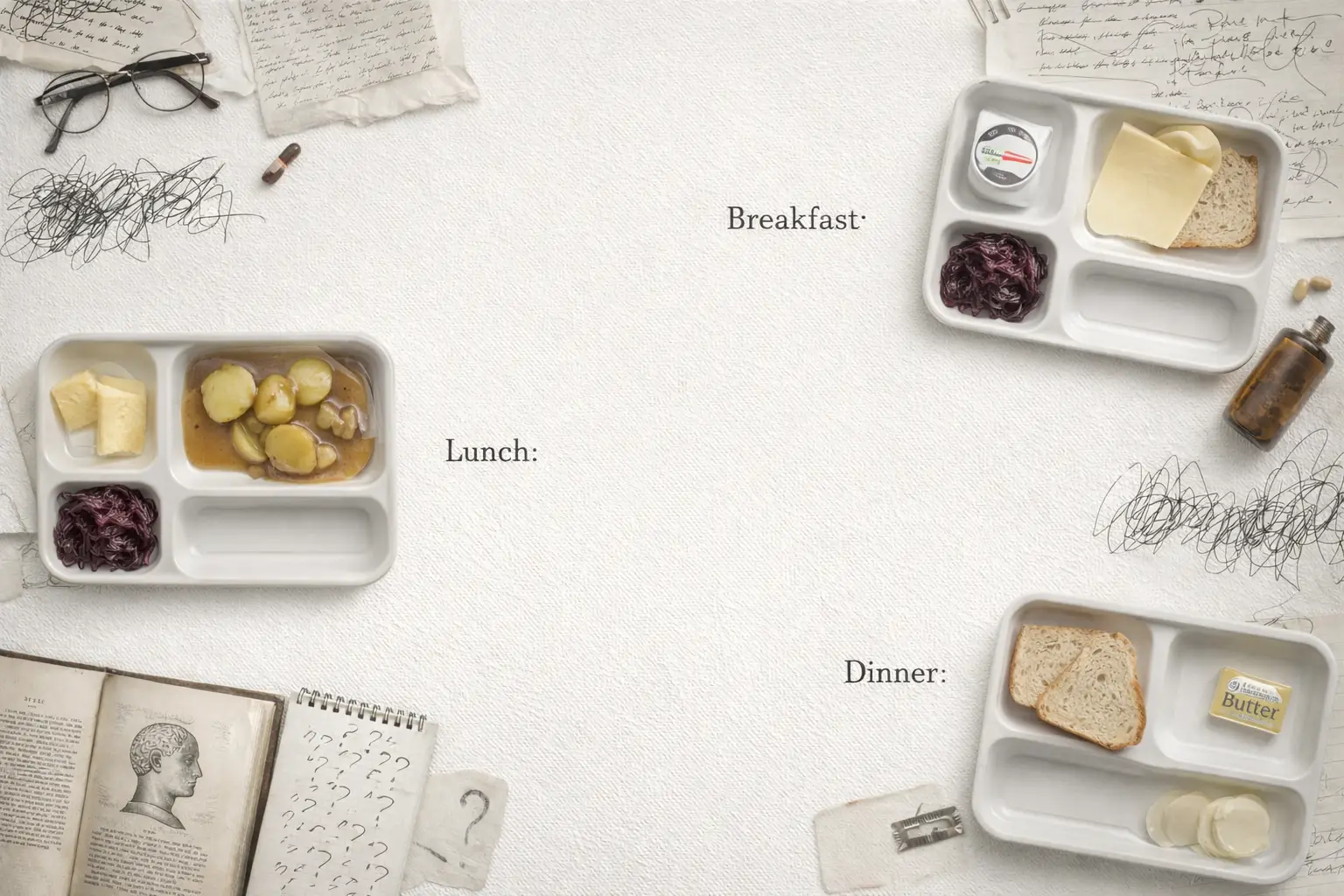
    German hospital food really is a full anthropological study, especially Track 2. It’s like they designed the meals by asking, “What if we removed joy?” And then doubled down.

    Breakfast:
    Cold bread. Cold cheese. Cold silence.
    Lunch:
    Some permutation of potatoes trying their best.
    Dinner:
    Cold bread again, as if the bread committed a crime and must serve a life sentence.

    And 6 pm?? My friend, that’s not dinner-time. That’s intermission. No wonder you’re starving by night — your body is like, “Excuse me, where is the actual food that sustains life?”

    I’ve only been here a couple of days, but the food alone is enough to make me question the architecture of civilization. You know when anthropologists talk about “ritual meals” and “shared cultural practices”? I feel like I’m inside one of those BBC documentaries narrated by David Attenborough: “Observe the German patient, in his natural habitat, quietly accepting a slice of unheated bread as his final meal of the day.”

    But the food isn’t even the whole story. It’s just the most edible symptom of a larger thing: the cultural shock, the unspoken rules, the absolute German precision even in places that feel like they should permit a little chaos.

    I’ve been here only a short while, but the routine hits me like a foreign alphabet. Everything runs on a clock that’s not mine. Meals at strange hours, lights out early, nurses walking with the confidence of people who know exactly how long the universe should take. Meanwhile I’m sitting there, a student who still thinks dinner should happen when the sun has given up for the day, trying to understand why everyone here seems perfectly okay eating a refrigerator at 6 pm.

    There is also the way they check on you. Not intrusive, not dramatic, just… scheduled. “Minute 27… time to ask him if he slept.” I’m not used to care delivered with this mathematical consistency. Here, care is a line item. Necessary, structured, efficient. And I’m learning to live inside this efficiency without losing the softness I grew up with.

    I have been living in Germany for one year and have never experienced this level of culture shock. I knew living in Germany required adjustment, but this is special edition level of adjustment. A speed run of cultural assimilation under fluorescent lights.

    Inside the hospital, time behaves differently. There are no responsibilities except to exist. No racing thoughts about assignments or emails or cooking or grocery shopping. Just… being here. Breathing here. Eating the culinary tragedy they call Abendbrot. And feeling things I’ve ignored for months because there was always something else demanding attention.

    It’s strange how getting admitted feels like both a collapse and a relief. A kind of surrender but also like my body speaking, “Stop. We can’t carry this alone anymore.”

    But the cultural shock hits like waves. When a nurse knocks even when the door is open. When people speak so gently it almost feels unreal. When someone says “You don’t have to explain if you don’t want to.” When dinner arrives and your entire ancestral lineage whispers, “Beta… where is the dal??”

    Nothing prepares you for the moment you realize that survival tastes different in every country.

    And my room… my room is a fucking box of depression. Four walls that press in like they’re taking notes on my sadness. Even the window opens to the back of hospital corridor.

    I don’t know how long I’ll be here. A few days, maybe a little more. But something in me knows this pause is necessary, even if uncomfortable. Even if unfamiliar. Even if the bread has no business being that cold.

    Healing is also a kind of migration. You leave the familiar terrain of suffering and try to enter a new landscape. The border crossing is messy, disorienting. The language is strange. The customs are different. The food is suspicious. But eventually, if you stay long enough, something shifts. You learn the rhythms. You find the warmth. You meet yourself again.

    But one thing for sure, I will not settle for cold breads for the dinner. It shouldn’t even be called the dinner… 6 p.m. is no dinner.

    They have asked me to provide a list of things which I cannot eat. And this is my list:

    idk if they’ll agree on the requests

    I am letting myself be taken care of. Letting myself soften. Letting myself slow down enough to finally feel the things I’ve survived.

    And maybe, someday, when I’m outside again, I’ll look back and laugh at the cold bread and the quiet halls and the cultural confusion. Or maybe I’ll just carry this place with me as the first moment in months when life paused long enough for me to notice myself again.

    But never in my life I will start liking the German eating habits.

  • You Don’t Even Have a Week?

    You Don’t Even Have a Week?

    I self-harmed again.

    I don’t know how to soften that sentence, so I won’t. The voices had been getting louder over the past few days, and by the time last night arrived, I felt like I was sitting inside a machine that had forgotten how to turn off. The voices spat names, promises, and warnings. I felt stripped down to the bone.

    I felt very different when I finally reached the emergency clinic. I felt a strange kind of silence. The clinic also has this certain kind of sharp, clean, and distant smell, like metal and ethanol mixed with something human you can’t quite name.
    The doctor dressed my arm. The antiseptic smell almost made me cry. It wasn’t the pain. It was the calmness of someone just doing their job, like this kind of wound is a line they cross daily.
    I said very little.
    She moved with quiet precision: cotton, gauze, tape, done. I watched her hands instead of her face, the way they didn’t tremble, the way they had probably done this hundreds of times before.

    When asked, I told her that I had trouble sleeping lately. So, she gave me quetiapine for the night, said it would help me sleep, help quiet things down. Quiet—how strange that calm could come from a pill. I nodded, pretending I understood what that kind of quiet might feel like.

    It did quiet things down. Not completely, but enough for a few hours of dreamless black.

    I was called back again today.

    I sat in the waiting hall. The chairs are half-blue, half-grey, always a bit sticky from disinfectant. People came and went. There was a faint hum of people: footsteps, the shuffle of coats, the soft thud of doors closing.

    I was shaking my legs violently, as if the movement could drain something out of me. It’s obviously the side effect of the meds, but in that moment, it felt more like a quiet rebellion of the body against the calm it was being forced into. I kept repeating to myself that I just needed to show up, say things were “okay enough,” get my prescription, and leave.

    Then she walked by.

    Dr. H.
    Dr. H is the boss of the doctors. Not the final boss, but the penultimate one. She wasn’t supposed to see me. Not today, not like that. She was crossing the hall with a bunch of people following her, probably heading to some meeting, when her eyes caught mine.

    It wasn’t even a full second. But I waved — half out of politeness, half out of this feeling that exclaims, “Hey, I know you, do you remember me?”. She stopped, turned, and in that moment, she recognized me.
    She scanned me, head to toe. Not judgmentally, just… clinically, but with a sort of quiet alarm. Like when a scientist suddenly realizes the experiment isn’t stable anymore.

    “I think you need to be treated here with us,” she came very closed to me and whispered. “Every week we have a meeting, and your name came up, and I recognized you.”

    I froze. There was no way to hide the exhaustion. “Umm,” I said, “I know, but I’ve taken too much work at the university. I can’t afford to be admitted.”

    She tilted her head. “You don’t even have a week?”

    I laughed a little. The brittle kind of laugh that tries to sound normal but isn’t. “I’m very sceptical,” I said. “I have too much on my plate.”

    She looked at me for a moment, not impatient, not surprised. Just quietly studying me, as if to check whether I actually believed what I was saying.

    “How is it going with university?” she asked. “Concentration and all?”

    I looked down at my shoes. “I know it’s very bad,” I said, “but I have to manage, I guess.”

    She sighed… not dramatically, just the kind of sigh that comes from someone who already knows how the story goes. “You need to come here,” she said. “Otherwise it’s not going to work. Taking meds at home only will not work.”

    And she was right. I knew she was right.

    But still, I said, “Okay, I’ll think about it.”

    When she walked away, I stared at the door she had disappeared through. I wanted to disappear with her, into whatever place she thought “here” meant. Into a place where the voices would quiet down, where I could stop pretending I’m managing. But I also wanted to leave, to run back to my messy desk, my emails, my lab notes, the fragile scaffolding of “normal life” I’ve built around myself.

    Later, when I got in with the doctor I was actually scheduled to see, she asked how last night was. I told her, “It was okay. I heard voices, but I guess this is what we have to deal with.”

    She didn’t flinch. She just nodded, wrote something down. Then she asked what I thought about Dr. H.’s suggestion.

    I said, “I have a presentation on the 17th. After that, I can come for the treatment.”

    She said that sounded like a good plan.

    So, I guess I’ll be spending half of November in the hospital.

    There’s a strange kind of relief in saying it out loud like I’m signing a temporary peace treaty with myself. A break in the war I keep fighting quietly. But that is not the truth, the truth is, I’m tired. Tired in the bones. The kind of tired that makes even sleep feel like work.

    It’s not that I don’t want to get better. It’s that I don’t know what “better” looks like anymore. There was a time when I thought it meant finishing my degree, publishing papers, working in clean labs with humming instruments. That it meant returning to a stable graph, a steady equilibrium. But lately, “better” just means no trying to figure out in what ways that my brain sometimes can turn against me.

    Quetiapine helps in the way a heavy blanket helps during a thunderstorm; it muffles the noise, but the thunder is still there, somewhere behind the fabric.

    When Dr. H. said, “taking meds at home will not work,” I think she meant something deeper. Not just about medication, but about the illusion of self-sufficiency. I’ve spent so much time trying to keep my illness quiet, to make it coexist with my studies like it’s just another variable to be controlled. But it isn’t. It leaks into everything. Into my attention, my sleep, my relationships (if I have any), my words.

    And maybe that’s what scares me about being admitted; the idea of finally stopping. Because stopping means facing it. It means being seen without the usual props of productivity or competence.

    Still, part of me knows I need to go.

    I think about how small the world becomes when you’re afraid of your own thoughts. How even your own name can feel foreign, like it belongs to someone else who’s gone missing.

    I picked up my phone to call my sister, but couldn’t tell if the phone was real. Everything blurred, as if the room had rotated slightly out of alignment. I remember trying to breathe slowly, but the air felt like dream.

    That’s when the idea of hurting myself stopped feeling like a “bad idea” and started feeling like a way to see again, to prove the world was still solid. It’s hard to explain that logic to anyone who hasn’t lived inside it. It’s not about wanting to die. It’s about wanting something to feel real.

    But afterward, all I felt was shame.

    “You don’t even have a week?”
    It’s a simple sentence, but it carries weight. She wasn’t asking about time; she was asking about permission. Permission to let myself rest, to stop performing survival as if it’s an assignment due at midnight.

    The truth is, no one at the university will really remember whether I missed a week in November. But I will. I’ll remember if I pushed myself into another breakdown just to finish a slide deck.

    There’s a quiet cruelty in how academia measures success. You have to show attendance, output, meet deadlines. As if mental health can be scheduled around presentations. I’ve tried to keep up. I’ve tried to be the student who can balance both worlds: the lab and the clinic. But the truth is, the voices don’t care about deadlines. They come when they want, and they don’t stop just because I have class at 8:30.

    I am very worried about my university work. I am afraid I will fail courses if I get admitted and lose the most of my valuable time in the university. Every week feels crucial now, every lecture, every lab, every piece of progress. The idea of stepping away, even for a short while, feels like letting everything I’ve been holding together start to fall apart.

    But if I do get admitted, maybe that’s okay. Maybe this is the kind of experiment that requires surrender. To stop running the test alone, to let the others observe, adjust, intervene. Maybe, maybe “treatment” isn’t failure.

  • The Trade

    The Trade

    TW: SELF HARM!!!

    It’s been a few days since that night, and I’m still trying to decide what was real and what was dream. The voices were louder than they’ve been in months, and there was a moment when the whole room seemed to tilt. I remember the blur of it more than the detail.

    When they started shouting over each other, it was like the walls pulsed. I tried to focus on one sound, one word, anything that could anchor me, but everything slid sideways.

    Then they made me an offer I could not refuse.
    They told me they could give me silence.
    A trade.
    What did I have to do?? Inflict pain, uncage it, let it flow.
    I don’t remember the logic of it, just that the idea of quiet felt holy. I thought if I could stop the noise, even for a few minutes, maybe I’d find myself again.
    When it finally went still, I didn’t feel relief, I felt numb. I watched myself as if from a few feet away, detached and weightless. It should have frightened me, but it didn’t. It felt like floating.

    I did left a message to my sister before all of it. But she was sleeping. Time runs 4 hours 30 minutes ahead of me there.

    A blade? Knife? Or maybe a cardboard cutter? Something so ordinary it shouldn’t hold that kind of power. But it did.
    I watched it rush out as fast as it can as if my body had been waiting for that one small opening. The blood came like water released from a dam… urgent, wild, free. It didn’t drip; it raced. It wanted out. And for a moment, I wasn’t scared. Just… quiet.
    Watching it, I remember thinking how unreal it looked. Like it wasn’t mine. Like I was only witnessing the event, detached from it, like an outsider to my own biological breakdown.

    Today I was on a video call with my mom and my sister. Mom noticed before I could cover anything up. She asked what happened, then started talking fast, praying under her breath between sentences. My sister hovered below her, already searching for remedies. Control your mind, meditate, breathe, think of God, listen to bhajans. Their worry was real, but it felt like a language I couldn’t speak. They believe faith can reorder chemistry.

    Every time someone says, “You just have to control your thoughts,” I want to hand them my brain for five minutes. Let them see what it means when your thoughts stop being yours. When your mind speaks back with its own voice. When you live inside a chorus you never auditioned for.

    They think it’s laziness, weakness, demons, karma, moral decay, everything except what it is: an illness that rewires perception, that changes the way sound and thought are built. It’s not romantic. It’s not poetic. It’s a fucking work. Every single day.

    I don’t need to “think positive.” I need people to stop acting like positivity is a cure for physics. I need them to stop hiding behind the word spirituality when what they mean is discomfort. Because that is the truth. They see it as chaos invading the safe order of their lives, and instead of sitting in that discomfort, they try to fix me back into their idea of normal.

    Normal.
    I’m tired of it.
    Normal people want stories of recovery that sound like redemption arcs. The brave patient, the healing music, the miracle meditation. They want illnesses to be neat, instructive, inspiring.
    It isn’t.
    It’s messy, tedious, cyclical.

    I wanted to shout out my disagreement loud. But I didn’t argue.
    I told them I’d try the breathing exercises.
    Sometimes I even do.
    Not because I expect them to fix anything, but because breath is something solid to hold when everything else turns abstract.
    The rhythm of air going in and out is proof of a body still here.
    And maybe that’s all I need some days.

    They meant well. They always do. But there’s this vast distance between caring and comprehension. They see it as something moral, something that can be disciplined or prayed away. I don’t blame them. It’s what the world taught them, that suffering is a failure of faith.

    I tried, once, to explain what it’s like. That the voices aren’t metaphors or moods, that they bend sound itself, that they rewrite the air around you. That it isn’t about willpower. It’s not about weak minds or strong hearts. It’s about misfired signals, about synapses painting over reality with their own colors.
    But my words never land the way I mean them to.

    But that does not deny the fact that I hate how “mental health awareness” gets packaged online. Pastel graphics, quotes about self-love, the illusion that you can fix your brain with morning routines. It’s a performance of empathy, not empathy itself.

    Awareness isn’t the same as understanding. Understanding requires discomfort. It means asking hard questions, staying with ugly answers.

    The voices are quieter now, though not gone. They hover like background noise.

    The night of the trade feels far away now. I am somewhat ashamed of myself. But I forgive myself too. There was no other option. I know it could happen again; that’s the nature of this thing. But I also know I’ll be ready in ways I wasn’t before. Or maybe I’ll give in again, who knows.

  • Astro

    Astro

    Astrophysics was my love.

    I wonder why I left it and started doing solid state physics.
    Maybe because I got influenced by M, “You will have more options here.” maybe it was that quiet bitterness that comes after too many small sacrifices, the whisper that says, “Why should I be the one to sacrifice every time?”

    Maybe I ran away.
    Maybe I was coward enough to escape the burden of expectation, the endless chase for a discovery that might never come.
    Or maybe the purpose of doing it died with S.
    She loved the stars more than I ever could. For her, astronomy wasn’t just science; it was intimacy with the infinite. She looked at the night sky like someone remembering home. After she was gone, the sky stopped being a place to look into and became a place to look at.

    Sometimes I think I didn’t just leave astrophysics. I left a version of myself that still believed in wonder. To be very honest, I never liked solid state physics. Crystals, currents, and lattices… they feel too confined, too obedient. The equations don’t wander; they stay where they’re told. Everything is measurable, everything repeatable. There’s no mystery left, no silence that stretches into awe.

    But I like what I get to do in the labs. Labs are fun in solid state. I am currently working on implementation of a python based experimental control framework for optical characterization of semiconductor quantum devices. It’s intricate, frustrating, and strangely alive. There’s a quiet satisfaction in watching machines respond to code.

    It’s fun, yes.
    But sometimes, in the middle of coding, I catch myself thinking about photons traveling through interstellar space. The real ones, not the ones bouncing inside a cryostat. The difference between cosmic light and lab light is distance. Scale. Meaning. The photons I measure now are domesticated; they behave. The ones from the stars arrive wild, aged, touched by the dust of centuries. I miss that kind of light.

    I also got my office today. I have to share this office with M.
    Of course. The universe has a sense of humor. I wanted distance, but somehow, I keep getting pulled back into her orbit. She doesn’t mean harm, but her presence is gravity: subtle, inevitable, unasked for.

    She wasn’t there today, that was a relief.

    I sat alone for a while, pretending to arrange my things, but really, I was just looking at the patch of sky visible through the window. It’s not much, half a rectangle of fading blue. I wonder what S would have said about it. Probably something about how even city skies have stories if you learn to squint right.

    I think about S often when I code.
    How she’d tease me for giving up the cosmos for semiconductors.
    How she’d say, “You traded galaxies for grids.”
    She’d laugh, that half-sincere, half-sarcastic laugh she always had when she was right. And I’d pretend to defend myself, “But it is still physics.”
    And she’d say, “Yes, but not the kind that breathes.”

    I don’t think I ever told her, but I envied how easily she could love things that were beyond reach. I always wanted to understand the universe; she wanted to belong to it.

    Okay okay… this post is becoming more about S and less about my thoughts. But then again, I am thinking about S, so maybe that’s fair.

    I also went to the exercise class for Introduction to Solid State Physics I. The professor was livid when none of us showed interest in presenting the solutions to the problems. And when a group did, we as audience were half dead. He said, “You guys are master’s students. You need to keep up. This is not the standard we are setting here. This is not acceptable.”

    He seems passionate about the subject. You can see it. The way his voice sharpens when he talks about Drude, or Sommerfeld Model, the way he looks disappointed when we don’t respond. He loves this subject. I almost envy that.

    But on the other hand, there’s me.
    Too shy. Too underconfident to go and present in front of the class.

    And even when I want to, my mind betrays me. Words vanish mid-sentence. My speech stumbles; thoughts scatter like frightened birds. I hate it. The feeling of being trapped behind a glass wall, knowing what you want to say but unable to make the sound.

    Negative symptoms of Schiz. I hate them more than the positive ones. The voices at least come and go, but the emptiness stays. The hesitation, the quiet disconnection… it builds a wall between thought and speech.

    Maybe that’s why I prefer silence.
    Silence doesn’t humiliate you.
    Silence doesn’t misfire halfway through a sentence

    And I don’t think professors understand how much courage it takes just to stand up and say something when you feel that way. They think silence is laziness, but sometimes silence is survival.

    Anyway, when I look back, so much of my decisions depend on other people rather than mine. How strange it is, how much of my life seems shaped by other people’s gravity.

    S said “look up,” and I did. Until I couldn’t anymore.
    M said “options,” and I changed my orbit.

    Maybe that’s what most of us do: move around the pull of other people’s certainties until we can’t tell which direction was originally ours. I keep wondering who I would have been if I’d stayed stubborn, if I’d fought harder for the sky. Would I have been braver or just lonelier in a different way?

    I don’t know if I’ll ever go back to astrophysics.
    Maybe I couldn’t even if I tried. The math has moved on, the people have moved on, and maybe the version of me that once belonged there no longer exists.

    Still, I keep some ritual. I try to look at the night sky when I am alone. Try to find stories in the sky. If I get my eyes on a cluster of stars, I try to name it, like an apology. I imagine S somewhere in that direction, laughing at my sentimentality.

    “You’re still at it,” she’d say.


  • The Appointment

    The Appointment

    “So, how are you feeling?”

    “Right now or how have I been feeling lately?”

    “Yeah… right now, or in general, whatever you want to tell me about.”

    What do I tell her? That I am not good? That I am suffering? That sometimes even the act of describing how I feel feels like another kind of illness?

    I could say, “I’m tired,” but that’s not it. Sleep doesn’t fix this kind of tired.

    I could say, “I’m managing.” Managing means functioning well enough to not raise alarms, but not well enough to feel alive. Managing means I can answer messages, go to appointments, smile at the right moments all while quietly falling apart where no one can see.

    “I am okay. I guess.” I finally give an answer. Okay… okay has no truth to it. No lies either. What is okay anyway? I guess it’s the silence between chaos and confession, a word people use when they’ve run out of ways to be honest.

    “Okay? From your email, I feel like you are far from being okay.”

    I look down at my hands. They always betray me first. Restless, fidgeting, never knowing where to belong. I want to say, You’re right, but something in me resists agreement.

    “I don’t know. The past few weeks have been pretty bad for me. I haven’t gotten good sleep, or gone out. I missed all my lectures. I just… stare at the wall and lose track of time.”

    She writes something down. I always wonder what she writes. Does she write paranoidly delusional or the patient look stable. Maybe she writes nothing at all, just draws little boxes to contain the things I can’t. She then looks up. “Why didn’t you leave your home? Were you scared?”

    “Not scared particularly,” I say. “I just didn’t feel like doing it.”

    “And what about the thoughts of your friends harming you or trying to poison you?”

    I hesitate. The question lands like a needle. “Yeah,” I say finally. “I still believe they are after me. I haven’t eaten the food given by them. I threw them out.”
    I can hear myself saying it and it sounds absurd but also absolutely true. That’s the paradox of it: reason and certainty fighting for the same seat.

    “Why do you think they would harm you?”

    “I don’t know. I just feel like it. Everyone has been trying to distance themselves from me. They’ve been ignoring me.”

    There’s a pause, not judgmental, just careful. “And what about the thoughts of self-harm?” That question always arrives like a checkpoint. I know she has to ask it. Still, it slices the air.

    I take a deep breath. “I do have such thoughts. This one in particular — I’ve been contemplating it. You know how silk, when burned slowly, releases hydrogen cyanide? I thought… if I could trap that and inhale it, it would be such an interesting way to go.” I look at her, steady. “But I’m not going to act on that.”

    She doesn’t flinch. “What about the voices?”

    “I’m not having loud voices,” I say. “But today, while sitting in the waiting hall, I heard them again. Like a radio between stations. Faint, crackling.”

    “What were they saying?”

    “I don’t know. Too faint to comprehend.”

    She leans back slightly, exhales. “Okay,” she says softly. “I believe you’re not doing well, and I think you should consider being admitted to the clinic or at least enroll as a day-care patient.”

    “I don’t have time,” I say quickly. “I’ve already taken up too much in the university. I have to write my thesis and everything.”

    “But you said you’re hardly even going to the university.”

    “I’ll start going from this week,” I promise, as if saying it could make it true.

    “Okay then,” she says. “We have to do something with the medication. Are you okay with that?”

    “Yeah.”

    “How have you been taking your meds?”

    “Abilify in the morning, Amisulprid in the morning and evening.”

    “And have you been taking them regularly?”

    I look down. “No. I’ve been skipping them quite a few times.”

    “Why?”

    “I wanted to feel like myself. With the meds, everything’s just… same. I don’t feel joy or happiness. Everything is grey.”

    “Do you know which medicine is causing that feeling?”

    “No.” I almost say all of them but stop myself. She’d take it clinically; I mean it existentially.

    She nods slowly. “We have to give the meds a full try. You have to take them regularly before we can decide where to go next with your treatment.”

    I stay quiet for a moment, tracing the grain of her desk with my eyes. Then I say, “My grades have fallen like crazy. Last semester I got a 1.0, but this semester I got 3.7. I barely passed. My mind goes blank too often now. It’s like I forget what I was thinking. When I try to explain something to someone, the thought just disappears mid-sentence.”

    She sighs, almost tenderly. “That’s an indication that you’re ill. And it will be very tough for you in the future. You must focus on your health. If you try to do everything… study, thesis, recovery… it’ll be too much.”

    Her words make sense. They also make me feel smaller. And what does she mean that everything will get tougher in the future? Like life already isn’t tough enough for me. And what does she mean by Ill? The word still feels foreign, like a label someone else pinned on me when I wasn’t looking.

    I also tell her about my website. How I’ve been writing, quietly, trying to make sense of everything.

    “That’s good,” she says. “Writing can help.”

    I nod, though what I want to tell her is that writing isn’t therapy, it’s survival. It’s how I prove I still exist somewhere.

    She looks for a date and writes down the next date of appointment for me. It’s in December. Things are so slow here in Germany. I wish I could meet her a bit early. The paper slides across the desk, white and final.

    Before I leave, she says, “Take care of yourself, okay?”

    That sentence always sounds simple, almost casual. But it’s heavy when you think about it. Take care of yourself, as if “yourself” were something you could carry in your hands.

    I nod. “I’ll try.”

  • Technically, Today

    Technically, Today

    Today, I will go to my doctor.
    I don’t know what to say to her. How do you condense months of chaos into fifteen minutes across a desk? How do you speak about something that still feels unspeakable?

    I did send her an email a few days ago. When I wrote her the email, I think I was really writing to myself. To the version of me who still thinks that someone out there might listen without turning away. Maybe I was testing the limits of trust.

    Since sending it, I’ve been rehearsing what I might say aloud. But I don’t seem to really speak out any of my thoughts out. I picture the scene… the quiet room, the pen in her hand, the measured tone in her voice, and suddenly everything inside me turns to static. It’s not the fear of her, exactly. It’s the fear of sound. Once something leaves your mouth, you can’t take it back. Written words can hide behind their own formality. Spoken ones live in the air; they vibrate too close to the heart.

    The first thing she asks is “How are you?”
    What should I tell her? How do I assess my situation? Sometimes I feel like God and sometimes I am at the lowest a person could get. There’s never an in-between. I live on a seesaw, and the middle has rusted away.

    When I’m up, everything feels connected. I can see patterns in randomness, meaning in stillness. The air feels full of messages only I can read. On those days, I don’t just feel alive, I feel necessary, as if my thoughts are a language the universe forgot to finish.

    Then it drops. It always drops. The same world turns grey, and I become a spectator in my own story. Even breathing feels performative, like I’m auditioning for the role of “normal human being” and failing miserably.

    How do I explain that swing in a doctor’s office without sounding either arrogant or broken? There’s no medical term for feeling both infinite and obsolete.

    If I say, “I am fine.” I will be lying.
    If I say, “Not Good,” she will ask why, and then the story will begin. And once it begins, there is no end. It spills, it floods, it takes shapes of everything I have been trying to contain.

    But I guess, it depends on what she is asking. “How are you?” as in, “How are you lately?” or “How are you right now?”
    In any case, I guess speaking the truth would be a better answer. But then again, who knows what the truth is.

    Sometimes I try to grade my existence like a test.
    How am I doing?
    Eating: sometimes.
    Sleeping: inconsistently.
    Working: yes, but at half-speed.
    Thinking: always, maybe too much.
    Feeling: unstable.
    Living: unclear.

    I wonder what she’ll see when I walk in tomorrow.
    Will she notice the exhaustion behind my smile? Will she read between my sentences like she always does? Or will she only see the polite version of me — the one that nods, takes notes, promises to be careful? I don’t know how to show her the difference between the person I appear to be and the one I actually am. The version of me who sits here in the half-dark, trying to make sense of existence by writing to strangers in the future.

    I re-read the email I sent her. I really did talk about the darkest of my secrets. I don’t know why I do that to myself. I keep wondering if I said too much. But then again, what’s the correct dose of honesty. Too little, and no one can help you. Too much, and you scare them away.

    The weather has been strange lately. It was all sunny in the morning and then it started raining all of a sudden. Not the kind where everything becomes gloomy… it rained with the sun out. Then it stopped. And around evening, dark clouds ate up the sky. And it rained the gloomy kind.

    Outside, the wind has started again.
    The windows rattle faintly, like teeth chattering in the cold.

    In reply to my email, she said, “Although you said you are not in a crisis right now, I think you are not very well and we should talk about your further treatment at our next appointment.”

    I try to imagine how the appointment might go.
    Maybe she’ll ask about the nightmares. Maybe she’ll adjust my medication. Medications — lol.

    I think my medications are slowly killing me. Not in a dramatic way, but more like erosion. I feel depressed as fuck. And I spend money like crazy. And world feels grey. I skip them to feel like myself sometimes. But it hurts my brain, I start hearing voices and I am too soft to not act on them.

    I think the strong medicines are also hurting my kidney, or my lungs, or liver… who knows. One thing is sure; I will live much less than normal people.

    I try not to think about how many years that actually means—much less than normal people.
    But then again, what’s “normal”? Who decided what amount of living is sufficient before the clock runs out? Sometimes I think intensity counts more than duration. Some people live eighty quiet years; others burn through thirty and still leave more behind.

    The thing with medication is that it’s both lifeline and leash.
    It keeps the floor from sagging but also nails my feet to it. When it’s working, I feel detached like someone turned the volume of the world down and also dimmed the light. Everything becomes bearable in the same way a waiting room is bearable: you’re not in danger, but you’re not living either.

    It’s past midnight now. I should probably sleep, but sleep doesn’t arrive on command. It negotiates. I have to make deals with it: if I lie still, if I stop checking the clock, if I promise not to think about tomorrow for five minutes, maybe it will give a visit. It rarely keeps its end of the bargain.

    Instead, I scroll through old photos.
    Me, smiling in a lab coat.
    Me, with friends I don’t talk to anymore.
    Me, pretending to belong somewhere.
    It’s amazing how well photographs lie.

    Anyway, Sometimes I imagine talking to her without the formalities. No small talk, no polite pauses. Just: “Hi, I’m scared of my own mind, and I don’t know if the medicine that keeps me sane is also erasing me.”
    That’s the truth in its purest form, but it’s not the kind of sentence you can drop casually into a consultation. It’s too heavy. It doesn’t fit in the allotted fifteen minutes.

    So I’ll probably end up saying something softer. Something like, “I’m managing.”
    And she’ll nod, maybe make a note.
    And I’ll wonder if “managing” means surviving or stagnating.

    “I think you are not very well and we should talk about your further treatment.”

    It’s such a professional sentence, but there’s care hidden in it. I read it again and again, trying to locate the exact temperature of her concern. Not too warm, not cold. Balanced.

    Still, there’s a small, stupid part of me that wants her to care beyond the boundary of her role. To look at me not as a case but as a person she actually worries about when she leaves the clinic. I know that’s unrealistic. People need distance to do their jobs. But loneliness has a way of making even rational thoughts bend, so.

    I will also go to collect my Residence Permit Card. It was such a pain to actually get that. I applied for it back in July, but didn’t hear anything until September, by then my visa had already expired. I had to write a long, nervous email to the Ausländerbehörde. When they finally called me for the interview, I was terrified. I had lost my job because of this sickness, and I didn’t have enough funds to show in my account. I walked into that office expecting interrogation, expecting judgment.

    But it went smoothly. Strangely smoothly. The officer didn’t ask about money, didn’t question anything, just typed something on his computer, nodded, and said they would issue me a residence permit for two years.

    Two years.
    I kept waiting for him to realize he’d made a mistake, to ask for another document, another proof. He didn’t. I walked out with the temporary paper in my hand, wondering why.

    I should have felt relief, but all I felt was confusion. How can a system that demands so much proof suddenly not ask for any? Maybe he saw the hospital entries in my record. Maybe he saw I wasn’t a threat to anyone but myself. Maybe pity is its own kind of visa.

    It’s strange how bureaucracy and psychiatry end up in the same sentence of my life now — doctor and residence permit both hanging over me like proof that I exist somewhere, officially. Papers and pills. Permission to stay. Permission to function.

    I don’t know how it’ll go… everything tomorrow; technically today. I’ll wake up, dress neatly, take the bus, answer questions. I’ll play my part.